Sustainability at the Heart of MetroLink
As one of Ireland's largest infrastructure programmes, MetroLink will play an important role in supporting sustainable growth, improving connectivity and helping people move around the Greater Dublin Area more efficiently.
By providing a high-capacity, electrified public transport system connecting communities across the Greater Dublin Area, including Swords, Dublin Airport and the city centre, MetroLink will help support Ireland's transition to a more sustainable transport network. The programme also provides an opportunity to promote innovation, develop skills, strengthen supply chains and create lasting value for communities, the environment and the economy.
Sustainability is central to our ambition and influences the decisions we make throughout the project lifecycle, from design and procurement through to construction, operation and long-term asset management.
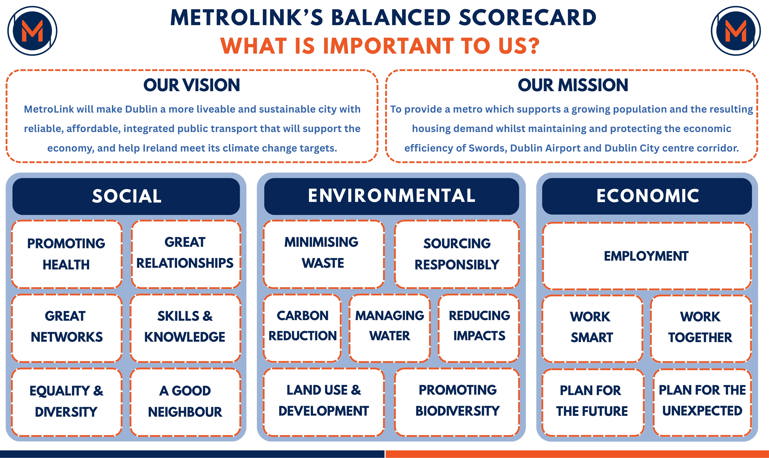
Balanced Scorecard
MetroLink has developed a Balanced Scorecard to guide supplier selection and define performance expectations to support contract management across the programme.
The scorecard reflects our strategic priorities and communicates the outcomes and behaviours that are important to the programme and provides transparency around how suppliers can contribute to MetroLink's wider objectives. These include:
- Environmental sustainability
- Social value and community impact
- Economic growth and innovation
- Responsible business practices
- Long-term economic, social and environmental benefits
We encourage prospective suppliers to consider the Balanced Scorecard when preparing tenders and developing delivery strategies.
Delivering with Our Supply Chain
MetroLink's supply chain will play a vital role in delivering the programme and helping achieve its sustainability ambitions.
We are seeking to work with suppliers that take a responsible approach to business, manage environmental and social impacts effectively and identify opportunities to create additional value through collaboration, innovation and continuous improvement.
This includes promoting responsible sourcing, ethical supply chain management and sustainable resource use. Suppliers may be required to demonstrate alignment with recognised sustainability standards, certification schemes and performance requirements relevant to the products, materials and services they provide.
MetroLink encourages suppliers to apply circular economy principles through efficient use of resources, waste reduction, reuse and recycling, and consideration of whole-life value.
Specific sustainability requirements will be set out in the relevant procurement and contract documentation.
Designing and Building for the Future
MetroLink is being developed with a long-term perspective. The infrastructure delivered today should continue to serve Dublin's future transport needs for generations to come.
Throughout design and construction, opportunities will be sought to improve performance, increase resilience and reduce environmental impacts.
MetroLink's stations, facilities and infrastructure are being designed with consideration of energy efficiency and environmental performance. This may include energy-efficient systems, high-performance materials, smart technologies and renewable energy solutions where technically and commercially appropriate.
Construction activities can have significant environmental and community impacts. MetroLink encourages approaches that reduce emissions, manage resources efficiently and minimise disruption to local communities. This may include the use of lower-carbon materials, reducing waste, protecting local habitats and watercourses, and minimising noise, dust and transport impacts.
The programme is also being developed with consideration of future climate risks and opportunities to improve resilience, helping to ensure the infrastructure remains reliable, adaptable and fit for purpose throughout its operational life.
Technology will play an important role in supporting efficient delivery and operation. Digital tools, data and innovative technologies can help improve decision-making, enhance asset management and support continuous improvement across the programme.
Environment
Protecting and enhancing the environment is a key consideration throughout MetroLink. By helping people make more sustainable journeys, the programme will contribute to wider efforts to reduce transport-related emissions and support the transition to a low-carbon future.
Our environmental priorities include reducing carbon emissions, improving resource efficiency, promoting responsible sourcing, protecting water resources, preventing pollution, enhancing biodiversity and supporting sustainable land use.
Supply chain partners can play a significant role in helping deliver these objectives through responsible sourcing, efficient use of materials and resources, reducing waste and emissions, protecting environmental quality and developing innovative solutions that improve environmental performance.
Carbon Management
Given the scale and lifespan of MetroLink, reducing whole-life carbon emissions is an important consideration throughout programme delivery.
This includes emissions associated with design choices, construction methods, materials, logistics and future operation. Where required through procurement or contract documentation, suppliers may be asked to monitor and report carbon impacts and identify practical opportunities to reduce emissions through design optimisation, material selection and efficient construction methods.
Social Value in the Supply Chain
Social value is about creating positive and lasting benefits for individuals, communities, stakeholders and wider society through the delivery of equitable social, environmental and economic outcomes.
While MetroLink will naturally generate significant social value through improved connectivity and mobility, suppliers are encouraged to consider how the delivery of their contracts can contribute to broader positive outcomes.
MetroLink's Social Impact objectives, supported through the Balanced Scorecard approach, are intended to ensure that the benefits of the programme extend beyond transport infrastructure and create lasting value for communities, businesses and society.
What This Means for Our Supply Chain
Depending on the nature of the contract, suppliers will be encouraged to:
- Create employment, training and skills development opportunities.
- Promote equality, diversity, inclusion and workforce wellbeing.
- Support inclusive and accessible outcomes through the design and delivery of goods, services and infrastructure where relevant to the contract.
- Engage positively with communities, schools, colleges and other local stakeholders.
- Deliver measurable social outcomes that create lasting benefits for people and communities.
Through these collective efforts, MetroLink aims to support the development of a skilled, diverse and resilient workforce while creating long-term benefits for the communities it serves.
Economic Growth
MetroLink represents a major investment in Ireland's future and has the potential to support economic growth long after construction is complete.
In addition to improving connectivity, the programme can help support productivity, innovation, skills development and supply chain capability across multiple sectors.
How Suppliers Can Contribute
Suppliers can contribute to wider economic benefits by investing in skills, supporting innovation, creating opportunities for SMEs and social enterprises, building resilient supply chains and sharing knowledge that improves productivity and long-term value.
By working together, MetroLink and its supply chain can help ensure the benefits of the programme extend beyond the railway itself and contribute to Ireland's long-term prosperity.
Measuring Progress
Delivering meaningful outcomes requires clear objectives, effective collaboration and transparent reporting.
MetroLink will work with supply chain partners to establish appropriate measures and reporting arrangements for relevant contracts. Suppliers may be required to demonstrate compliance with contractual requirements, report performance, provide evidence of outcomes achieved and participate in assurance or review activities where appropriate.
By measuring performance and sharing lessons learned, MetroLink and its supply chain can continue to improve outcomes and maximise the benefits created through the programme.
